
Ivy League Profile Building Guide
Complete Roadmap 2026
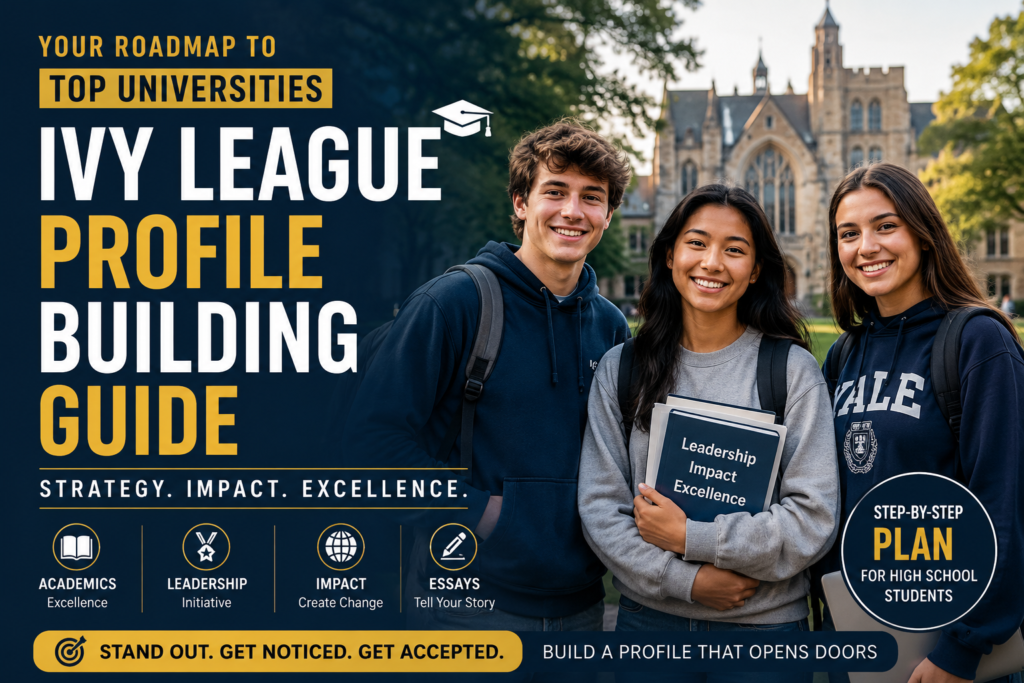
Getting into Harvard, Yale, Princeton, or Columbia is not just about high grades. This guide breaks down the exact framework — academics, spike, leadership, projects, essays — to build a standout, holistic profile that Ivy League admissions officers remember.
What Ivy League Actually Looks For
Ivy League universities — including Harvard University, Yale University, Princeton University, Columbia University, and their equally elite peers — are among the most competitive institutions on earth. But contrary to popular belief, they are not simply looking for top scorers. They are looking for memorable students.
They don't want a "perfect student" — they want a "memorable student."
Here is what admissions officers are genuinely evaluating when they review your application:
🎯 Academic Excellence
Consistent top grades and intellectual depth in your chosen subjects — not just marks on a sheet.
🔬 Intellectual Curiosity
Evidence that you seek learning beyond your syllabus, explore ideas independently, and think deeply.
🚀 Leadership Experience
Real initiatives, teams led, communities built — not just titles held on a resume.
🌍 Impact on Community
Tangible, measurable change in the lives of others through your work, projects, or service.
⚡ Unique Talent or "Spike"
One exceptional area of depth that makes your profile instantly distinct from thousands of applicants.
✍️ Strong Communication
The ability to tell your story compellingly and authentically — especially in your essays.
🔗 Long-Term Commitment in Activities
Sustained engagement over years in a few key areas, demonstrating genuine passion rather than resume-padding.
The Core Formula of Ivy League Admission
Think of your Ivy League profile as a 5-layer system. Every layer must be strong. If even one layer is weak, your overall chances drop significantly — regardless of how strong the others are.
= Your Ivy League Profile
Top 1–5% performance, subject consistency, advanced coursework. The entry ticket.
Your standout identity. One area where you are genuinely exceptional.
What you built, changed, or improved in the world around you.
Evidence that you can take an idea from concept to reality.
Where you win or lose admissions. Your authentic voice and personal narrative.
Academic Excellence — Your Foundation
Your academics are your base layer. Without a strong academic foundation, everything else weakens. Ivy League universities expect applicants to be in the top 1–5% of their academic cohort — but more than raw marks, they want to see intellectual depth and genuine curiosity.
- Top 1–5% academic performance in your school or board
- 90%+ consistency (or top rank in class)
- Strong subjects directly relevant to your intended career direction
- Advanced coursework — AP, IB, A-Levels where available
- Competitive exam participation — Olympiads, SAT/ACT
- Intellectual curiosity demonstrated beyond the textbook
- Subject depth, not just breadth of marks
- Only focusing on marks — ignoring subject depth
- Not reading beyond textbooks or standard syllabi
- Being average across all subjects instead of exceptional in core areas
Advanced Academic Strategy
"I study science."
"I built independent understanding of physics through experiments and research beyond the syllabus — exploring wave mechanics through hands-on projects."
🎯 Choose Your Strength Zone
Pick 1–2 core subjects and go deeper than any peer. Read university-level material early.
🏆 Compete & Prove It
Participate in Olympiads, national competitions, and science fairs to demonstrate academic credibility publicly.
📝 Write Research-Style Notes
Document your learning like a researcher. This habit demonstrates intellectual seriousness to any evaluator.
💡 Pro Tip
Instead of being average in all subjects, become exceptional in your chosen field — Math, Science, Economics, Literature, or beyond.
Also see: What SAT Score Do You Need for Ivy League Universities?
Build a Strong Spike — The Most Important Concept
A "Spike" = your standout identity. One strong area where you are outstanding — not just average in many things.
Ivy League admissions officers read thousands of applications from students who are good at everything. What makes you unforgettable is being exceptional at something specific. This is your spike — your calling card, your identity, the one thing that makes your profile immediately recognisable.
Ivy League does NOT want 10 average activities. They want 1–2 exceptional achievements in ONE direction.
Examples of Strong Spikes
Tech Spike
AI projects, app development, hackathon wins, open-source contributions, automation tools
Psychology Spike
Behavioral research, mental health awareness campaigns, peer counselling programs, case studies
Social Impact Spike
NGO work, free education programs, community development, environmental activism
Business Spike
Startups, e-commerce experiments, marketing campaigns, real revenue or users
Writing Spike
Published articles, literary journal wins, authored books or long-form independent journalism
Research Spike
Published or presented research, lab internships, climate studies, economics analysis
💡 How to Choose Your Spike
- What are you genuinely passionate about — not just what looks good?
- Where have you already invested the most time and effort?
- In which area can you realistically achieve something remarkable in the next 12–24 months?
- Does your spike connect logically with your intended major or future goals?
Also see: Profile Building Programs for US Admissions in Bangalore
Extracurricular Strategy — Depth Over Quantity
Not all extracurricular activities are created equal. The biggest mistake students make is stacking up participation certificates across dozens of one-day workshops or random clubs. Quality, leadership, and long-term involvement matter infinitely more than the sheer number of activities on your list.
- Random participation certificates
- One-day workshops with no follow-up
- Irrelevant hobby stacking
- Activities you joined just to add to your list
- Starting a club or original initiative
- Leading a team or organisation meaningfully
- Winning national or international competitions
- Research projects — especially with professors
- Real internships at actual companies
The Three Levels of Extracurricular Strength
School clubs, basic competitions. This is the baseline — everyone has this. It is not differentiating.
Team lead, organiser, club founder. You stepped up, took responsibility, and drove outcomes.
National recognition, real-world results, community change. This is Ivy-level territory.
"Member of debate club"
"Founded debate initiative that trained 50+ students and organised inter-school competition attended by 8 schools."
Ivy League prefers depth over randomness. Focus on quality + leadership + long-term involvement in a few areas that connect directly to your spike.
Projects That Make You Stand Out
Projects are the fastest, most concrete way to build a strong Ivy League profile. They serve as proof of your ability — evidence that you can move from idea to execution. A project without impact is a hobby. A project with real users or real-world benefit is an Ivy-level asset.
A project without impact or real-world benefit
A project with real users, measurable benefit, or community reach
Powerful Project Ideas by Category
💻 Tech Projects
- AI chatbot for students
- Study planner or productivity app
- Automation tools for a real problem
- Hackathon-winning solution
🌍 Social Projects
- Mental health awareness platform
- Free education website
- NGO donation or volunteer management system
- Community outreach campaign
🔬 Research Projects
- Climate impact or sustainability study
- Psychology behavior analysis
- Economics case study
- Financial literacy publication
Even small projects matter — what counts is whether they demonstrate problem solving, creativity, and execution. Your project should show that you identified a real problem and built something to address it.
Not Sure Where to Start Your Profile?
Our expert counsellors at EduQuest have helped students from across India build profiles that earned them places at top US universities. Get your personalised profile strategy today — completely free first session.
Leadership & Impact — The Hidden Differentiator
Leadership is one of the most misunderstood concepts in Ivy League applications. Most students think leadership means being Head Boy, Head Girl, or Club President. Ivy League admissions officers think differently. Leadership is not title-based.
"What position did you hold?"
"What did you build or improve?"
Real Leadership Examples That Impress Admissions Officers
📚 Starting a Free Tutoring Group
Identifying a gap in your community — struggling students — and taking initiative to fill it, recruiting volunteers, and measuring outcomes.
🎪 Managing School Event Logistics
Not just attending, but owning the planning, budget, team coordination, and execution of a major school or community event.
💻 Building an Online Learning Community
Creating a digital space — Discord server, YouTube channel, or learning platform — that serves real students with measurable reach.
📣 Running Awareness Campaigns
Designing and executing a campaign on mental health, climate, financial literacy, or another issue — with real participants and documented impact.
The question admissions officers are asking is always: "What change did you create?" — not "What did you do?" Every leadership experience on your profile should have a clear, answerable version of that question.
See also: Profile Building Programs for US Admissions in Bangalore
Essays — Your Personal Story
If academics are your entry ticket and your spike is your identity, then essays are where you win or lose Ivy League admissions. The personal essay is your one direct, unfiltered conversation with the admissions committee. It is the place where you stop being a set of grades and scores and become a human being with a story worth reading.
Your essay should feel like: "Only you could have written this."
What a Strong Essay Includes
📖 Personal Story
A specific, vivid moment or experience — not a vague summary of your achievements. Ground the reader in your world.
⛰️ Challenges You Faced
Vulnerability builds connection. Share real difficulties — not manufactured hardships, but genuine obstacles that shaped you.
🌱 Growth Journey
Show movement. Who were you at the start? Who are you now? What changed, and why does that matter?
🪞 Reflection
Demonstrate that you think deeply about your experiences. Admissions officers want thinkers, not just doers.
🎭 Clear Personality
Let your voice come through. Your humour, your values, your way of seeing the world. Be distinctly yourself.
- Fake or embellished stories — admissions officers have read thousands; they recognise inauthenticity
- Overuse of complex vocabulary that obscures rather than communicates
- Generic writing that could have been written by anyone
- Simply listing your achievements in paragraph form — that is what the activities section is for
Recommendation Letters
Recommendation letters are far more important than most students realise. They are the one part of your application that comes from someone else's voice — and admissions officers pay close attention to them. A weak, generic letter can undermine an otherwise strong profile.
"Generic praise — 'Riya is a hardworking and dedicated student who participates in class.'"
"Specific story — 'When our school faced a student mental health crisis, Riya independently organised a peer support group that served 40 students over six months.'"
How to Choose the Right Recommenders
✔ Choose Teachers Who
- Know you personally — not just academically
- Have witnessed your growth over time
- Can describe your leadership and character with specifics
- Are enthusiastic about writing your letter
✗ Avoid Teachers Who
- Only know you from test scores
- Have minimal personal interaction with you
- Are writing letters for many students with little customisation
- Cannot connect your work to your broader goals
💡 Pro Tip — Build the Relationship Early
Start investing in relationships with key teachers from Class 10 onwards. Participate meaningfully in their classes, share your projects with them, and keep them updated on your growth. The best recommendation letters come from teachers who have genuinely watched you develop.
Standardised Test Strategy
Even though many Ivy League universities have moved to test-optional policies, strong SAT or ACT scores still significantly strengthen your application — especially for international students from India, where the academic landscape is highly competitive and contextualisation matters.
Scores don't replace profile strength — they support it. A perfect SAT score with a weak spike and no leadership will not get you in. But a strong score alongside a compelling profile significantly boosts your competitiveness.
📅 When to Take the SAT
- First attempt ideally in Class 11
- Allow time for 2–3 attempts if needed
- Complete by August of Class 12 at latest
📚 How to Prepare
- Official College Board prep materials
- Khan Academy personalised practice
- Expert coaching for strategy and timing
See: What SAT Score Is Needed for Ivy League Universities? | Best SAT Coaching in Bangalore
Building a Timeline — Start Early, Win Consistently
One of the most common regrets among students applying to Ivy League universities is starting too late. Profile building is a multi-year process. Here is the ideal roadmap broken down by academic stage:
Class 9–10: Exploration Phase
- Actively explore multiple interests and activities
- Try different clubs, competitions, and creative pursuits
- Build strong reading habits — especially beyond the curriculum
- Begin identifying subjects you are genuinely passionate about
- Start building relationships with key teachers
Class 11: Spike & Leadership Phase
- Choose and commit to your spike — go deep
- Start serious, impactful projects tied to your spike
- Take on formal and informal leadership roles
- Begin SAT/ACT preparation and aim for first attempt
- Start building your project portfolio
Class 12: Application Phase
- Finalise and refine all applications
- Write, rewrite, and perfect your personal essays
- Complete SAT/ACT by August
- Request and nurture recommendation letters
- Finalise your university shortlist with Early Decision strategy
⏰ Starting Late — Class 12?
Class 11 is manageable. Class 12 late start is very challenging but not impossible — it requires intensive, focused effort and expert guidance to compress the profile-building process without sacrificing depth. Contact us for an honest assessment of your situation.
Reality Check — Trigger Points to Evaluate Your Profile
Before you move forward, ask yourself these five critical questions honestly. They are the fastest way to identify whether your current profile needs restructuring.
- Am I doing activities just for certificates — without any real passion or depth?
- Do I have a clear, defined passion area — or am I still spreading myself thin?
- Can I explain my entire journey in one coherent, compelling story?
- Have I created real, measurable impact — or just participated?
- Would a stranger who reads my profile immediately remember it?
You need profile restructuring — not just additions. It is better to make strategic changes now than to apply with a weak, unfocused profile. Call EduQuest for a free assessment.
Common Mistakes Students Make
The following mistakes cost students their Ivy League dreams every year. Read them carefully — and make sure your profile avoids every single one.
Explore More EduQuest Resources
- SAT Score Needed for Ivy League Universities — Detailed Breakdown
- Complete Ivy League Admissions Guide for Indian Students
- Profile Building Programs for US Admissions in Bangalore
- Best SAT Coaching in Bangalore — EduQuest
- How to Get Into Princeton University From India
- UCAT Coaching in Hyderabad — Medicine UK
FREE Download — Ivy League Profile Builder Blueprint
Get our complete, structured PDF blueprint used by students who got into top US universities. Packed with actionable tools, checklists, and strategy frameworks.
Comment or message us to get your free PDF sent directly to you.
Frequently Asked Questions
Yes, but it requires exceptional performance in other areas. If your grades are average, you need an outstanding spike — a uniquely deep area of expertise or achievement — combined with strong, tangible leadership experience and highly compelling personal essays that demonstrate real-world impact and genuine personal growth. Average grades lower your floor, so the ceiling of every other element must be higher.
Ideally from Class 9 or 10, when you have time to explore, make mistakes, and build genuine depth. Class 11 is still highly manageable — many successful applicants have started then. Starting in Class 12 is extremely challenging and requires intensive, expert-guided effort to make up for lost time. The fundamental principle is simple: the earlier you start, the more depth, impact, and consistency you can demonstrate in your application.
Both matter, and they serve different functions. Academics are your foundation — without strong grades, everything else weakens significantly. Extracurriculars are your differentiation — they transform you from a capable student into a memorable individual. Think of academics as the entry requirement and extracurriculars as the admission argument. A student with strong academics and weak extracurriculars is a candidate. A student with both is a contender.
Many Ivy League universities have adopted test-optional or test-flexible policies, meaning submitting SAT or ACT scores is not mandatory. However, strong scores — ideally 1500+ on the SAT or 32+ on the ACT — continue to strengthen an application, particularly for international students. If you have prepared well and achieved a competitive score, submitting it almost always works in your favour. If your score is below the median for your target school, the test-optional policy gives you the flexibility to withhold it.
There is no single factor — Ivy League admissions are holistic by design. However, if forced to identify the most decisive element, most admissions counsellors would point to the combination of a clear, well-developed spike and authentic, powerful storytelling in your essays. These two elements — a distinct identity and the ability to communicate it compellingly — are what separate the accepted applicants from the waitlisted ones. Everything else supports and amplifies these two pillars.
Ready to Build Your Ivy League Profile?
EduQuest has helped hundreds of students from India craft standout profiles for Harvard, Yale, Princeton, Columbia, and other top US universities. Your journey starts with one conversation. Call or WhatsApp us today — our first session is completely free.